


- Home >
- Tiger Institute
- > Cyber-Security
Cyber-Security
Autonomous and Intelligent Cyber-Physical System (AI-CPS) Laboratory
The Autonomous and Intelligent Cyber-Physical System (AI-CPS) Laboratory is a leading lab for research and education in artificial intelligence (AI), communications, cyber-physical systems, and cybersecurity. The lab's main objective is to provide critical infrastructure that enables and accelerates interdisciplinary, cutting-edge research and research-driven education spanning applied AI and machine learning for complex engineering systems, 5G and beyond wireless communications, autonomous vehicles and self-driving, and cyber-physical system security and privacy.
Dr. Liang Hong and Dr. Kamrul Hasan lead the AI-CPS Laboratory in the Electrical and Computer Engineering Department. Equipped with an integrated package of instruments from Quanser, Nvidia, and Ettus Research, this laboratory offers a unique environment for joint R&D programs with government agencies, academia, and industry. The facility includes the Quanser Autonomous Vehicle Research Studio with a motion capture system and a self-driving car studio upgrade, GPU server-based Nvidia 6G Development Platform, and Ettus Universal Software Radio Peripheral (USRP). The laboratory's primary physical platforms include the QDrone2 unmanned aerial vehicle and the QCar2 autonomous ground vehicle, which serve as representative physical plants for experimenting with and validating AI-enabled CPS algorithms. The Nvidia AI-native wireless stack for 6G integrates advanced AI across hardware, software, and architecture to prepare future networks for explosive growth in AI traffic. The USRP enables software-defined radio, bridging the gap between theory and practice and allowing researchers to move efficiently from simulation to real-world, high-bandwidth signals. The system's fully open hardware and software architecture enables flexible customization and supports tailored research development across a wide range of applications.
A key research thrust of the AI-CPS Laboratory is the security, privacy, and trustworthy operation of intelligent cyber-physical systems. Modern CPS continuously exchange sensor data, control information, and operational states across autonomous platforms, wireless networks, edge devices, and cloud systems. This connectivity creates opportunities for intelligent coordination while also introducing risks such as cyberattacks, adversarial manipulation, unauthorized access, data leakage, and privacy violations. The laboratory investigates AI-enabled anomaly and intrusion detection, adversarial attack defense, resilient control, trustworthy AI, secure autonomous operation, and privacy-aware system design.
The laboratory also emphasizes privacy-preserving data sharing and collaborative learning. Applications such as connected vehicles, UAV networks, industrial systems, and intelligent transportation often require multiple devices or organizations to use distributed data collaboratively. Research therefore explores federated learning, secure aggregation, privacy-aware distributed learning, and related methods that enable collaborative intelligence while minimizing exposure of sensitive raw data.
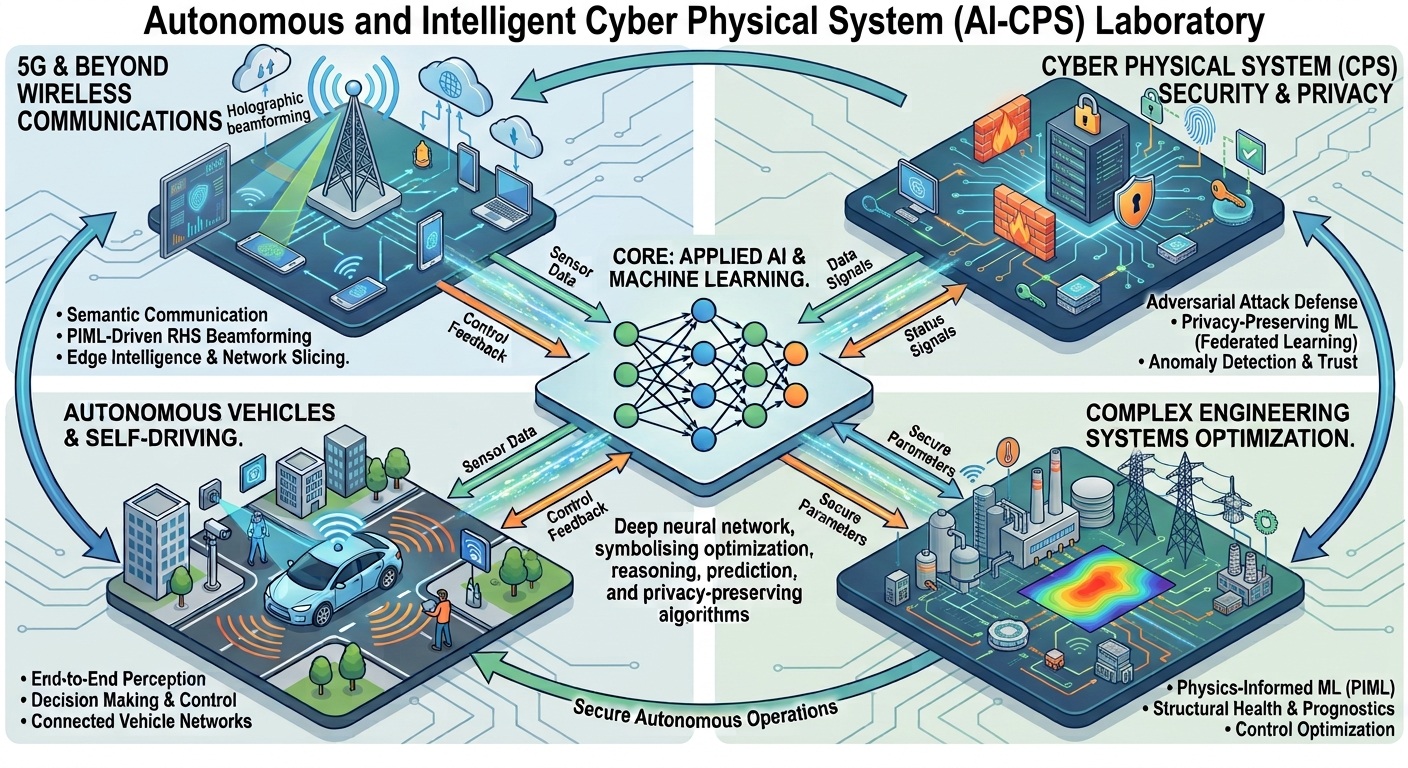
Figure. AI-CPS Laboratory Research Areas and Integrated Framework
Another important direction is privacy-preserving AI inference, where sensitive information remains protected while AI models make predictions or decisions. Techniques such as homomorphic encryption and privacy-preserving machine learning enable computation on encrypted or protected data, allowing edge or cloud platforms to provide intelligent services without unrestricted access to sensitive inputs. The laboratory investigates the practical trade-offs among privacy, security, accuracy, computational complexity, communication overhead, and real-time performance.
In 5G and beyond wireless communications, the laboratory supports research in AI-native networks, semantic communication, edge intelligence, intelligent resource allocation, advanced beamforming, network slicing, and physical-layer security. The USRP and NVIDIA 6G platforms allow researchers to move from theoretical and simulation-based studies to realistic wireless experimentation.
For autonomous vehicles and self-driving systems, QCar2 and QDrone2 support research in perception, sensor fusion, decision-making, control, connected vehicle communication, and secure autonomous operation. These platforms enable researchers to study how AI, communication, cybersecurity, privacy, and physical control interact in real-world cyber-physical environments.
The laboratory also supports optimization of complex engineering systems, including physics-informed machine learning, structural health monitoring, prognostics, and intelligent control. By
integrating physical knowledge with data-driven AI, researchers can develop more reliable, interpretable, and efficient systems.
A defining strength of the AI-CPS Laboratory is its ability to support end-to-end experimentation, connecting sensing, communications, AI, cybersecurity, privacy, and physical control within a unified environment. This capability enables research to progress from mathematical modeling and simulation to hardware-based and real-world validation.
Through this integrated research environment, the AI-CPS Laboratory aims to advance intelligent, secure, privacy-preserving, trustworthy, and resilient cyber-physical systems, provide students with hands-on experience, and support interdisciplinary collaboration among academia, government, and industry.
webpage contact:
Engineering