

Department of Environmental Sciences
Welcome to the Department of Environmental Sciences at Tennessee State University!
Dear family, friends, and supporters of the Department of Environmental Sciences,
Welcome to a vibrant academic community dedicated to understanding, managing and protecting our environment in a changing world. As part of the College of Agriculture, the department brings together passionate undergraduate and graduate students, faculty, and staff who are committed to environmental science, natural resource management, and geospatial technologies.
Our curriculum includes undergraduate studies (BS in Agricultural Sciences, Environmental Sciences concentration), master’s and doctoral programs, and graduate certificates in Applied GIS—all with strong research and training in forestry, resource management, geospatial science, soil science, and more. Students benefit from robust mentorship, advanced facilities, and active participation in research networks supported by the Institute for Food, Agriculture and Environmental Research. The department’s faculty specialize in climate change, urban forestry, environmental soil chemistry, water quality, and wildlife ecology, helping students build connections at local, national, and global levels.
Our programs prepare students for diverse careers—whether in private industry, government, academia, or nonprofit sectors—by addressing global challenges like land degradation, habitat loss, water scarcity, pollution, and climate change. Students gain classroom knowledge, practical research skills, and leadership experience through experiential learning, hands-on laboratory work, research assistantships, clubs, and networking opportunities. These experiences equip graduates to succeed in biological research, GIS analysis, environmental consulting, and teaching.
Our mission is to create solutions-oriented research and scholarship that promote sustainability and resilience in the face of environmental threats. The department is sponsored by agencies including NSF, USDA, DOE, state government agencies and industry partners, and is committed to preparing future leaders capable of collaborative, practical problem-solving.
We value the contributions and achievements of our students, whose engagement in research, teaching, and service drives our program’s success and impact. Together—with students, parents, and stakeholders – we strive to advance environmental knowledge and stewardship in Tennessee and beyond.
On behalf of the faculty, staff, and administration, thank you for your support and partnership. We invite you to learn, discover, and grow with us in the classroom, field, and laboratory, and wish you ongoing success and fulfillment at Tennessee State University. For support or guidance, please contact your instructors, academic advisors, or the department chair
Bharat Pokharel
Professor and Chair
Department of Environmental Sciences

Mission and Vistion of the Department of Environmental Sciences

Explore Environmental Sciences Faculty >>

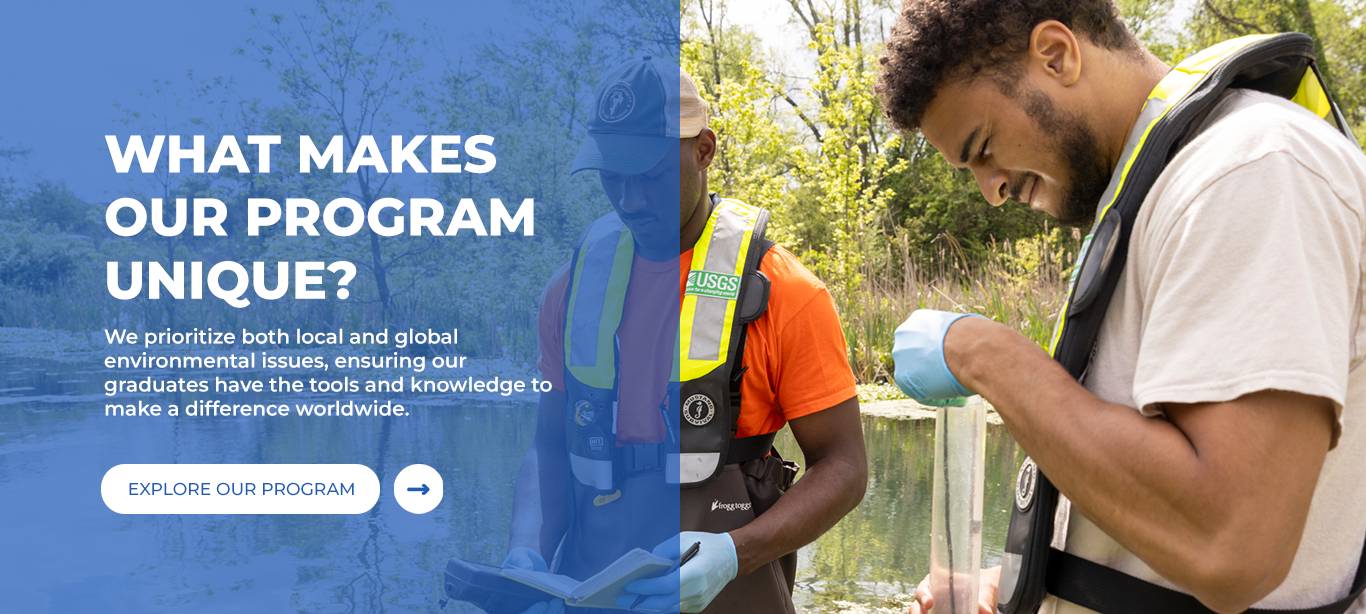
The Department of Environmental Sciences at Tennessee State University is about people working together to solve real-world environmental problems, not just completing assignments. Students and faculty form a close-knit community, spending time in the lab, in the field, and in conversations about how to make a tangible difference in their communities and ecosystems.
Research with real impact
Faculty in Environmental Sciences invite students into ongoing projects that address water quality, soil science, forestry, urban forestry, agroforestry, climate and land-use change, ecosystem health, and the sustainable use of natural resources. Students do not just observe; they collect samples, run experiments, analyze data, and share results in ways that matter to decision-makers and local communities.
Faculty know students by their first names
Every faculty member is actively involved in research and brings that experience directly into the classroom and mentoring relationships. Students get to know their professors as scientists, advisors, and collaborators who are deeply invested in their growth and future paths.
Spaces built for discovery
Students learn in modern laboratories equipped with cutting-edge instruments and at field sites designed for environmental work, including testing water and soil, mapping landscapes with GIS and remote sensing, and studying plants, wildlife, and ecosystems. These spaces become places where students try new ideas, make mistakes safely, and discover how environmental science works in real-world applications.
Learning by doing
Every course emphasizes hands-on experiences, from local field trips and lab-based experiments to semester-long research and community projects. By graduation, students have a portfolio of real-world skills in experimental design, data collection, analysis, and scientific communication that prepares them to step confidently into environmental careers or advanced study.
Faculty Research Interests and Focus Areas:
- Applied GIS and spatial analysis (Dr. Reginald Archer)
- Soil health (Dr. Sougata Bardhan)
- Water quality and geology (Dr. Thomas Byl)
- Urban and community forestry (Dr. Yujuan Chen)
- Climate change and biogeochemistry (Dr. Jianwei Li)
- Forest ecology (Dr. Sarah Neumann)
- Soil physics (Dr. Felix Ogunmokun)
- Biostatistics, forestry and forest biometrics (Dr. Bharat Pokharel)
- Environmental soil chemistry (Dr. Sudipta Rakshit)
- Wildlife ecology (Dr. William Sutton)
- Forestry, and small woodlands management (Dr. Huseyin Tecimen)
- Urban forestry (Dr. De’Etra Young)
Faculty members engaged in reseach and extension activities related to environmental sciences from sister departments within the College of Agriculture
- Applied remote sensing and GIS (Dr. Clement Akumu)
- Forage agronomy (Dr. Krishna Bhandari)
- Agronomy, biofuel and bioenergy (Dr. Jason de Koff)
- Cropping system (Dr. Philip Hinson)
- Ecology (Dr. Dafeng Hui)
- Irrigation engineer (Dr. Behnaz Molaei)
- Agronomy, and climate smart agriculture (Dr. Resham Thapa)

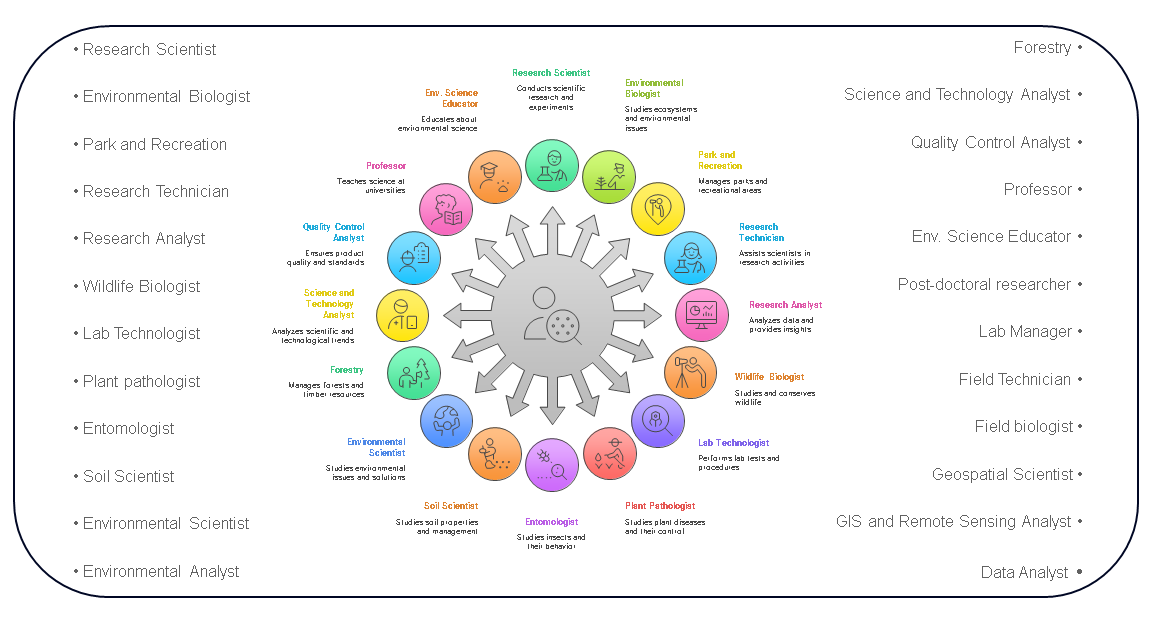
Wildlife Manager • Horticulturist • Zoologist • Microbiologist • Soil & Plant Scientist • Ecologist • Sustainability Consultant • Waste Management Officer • Water Quality • Scientist • Nature Conservation Officer • Wetland & Stream Ecologist • Natural Resources Specialist • Land Use Planner • GIS Technician • Environmental Safety • Officer • Invasive Species Specialist • Seasonal Aquatic Biologist • Park Ranger • Geologist • Environmental Compliance Manager • Environmental Geologist

You may find a complete degree map here for B.S. in Agricultural Science with a Concentration in Environmental Sciences.
Students may check degree works here so that they can plan their course registration in consultation with their academic advisor or faculty mentor.
Access degree works here >> (login required)

The College of Agriculture offers several financial support opportunities designed to help students fund their education. Students may apply for the Dean’s Scholars Program or the Leadership Development Program to receive additional assistance and enrichment.

Dr. Bharat Pokharel, Department Head
(615) 963-6054 |
bpokhare@tnstate.edu
Contact us by email at: envs@tnstate.edu
Office of Administration, Department of Environmental Sciences

Dr. Bharat Pokharel
Professor and Department Head
Department of Environmental Sciences
College of Agriculture
112 Farrell-Westbrook Complex
Telephone: 615-963-6054
Fax: 615-963-5436
Email:
bpokhare@tnstate.edu
Administrative Assistant (currenly open)
Farrell-Westbrook Complex
Email: envs@tnstate.edu
News
AG PROFESSOR RECEIVES HONOR
Coming Soon
STUDENTS ATTEND ORIENTATION SESSION
Coming Soon